
Abstract
In the modern athletic apparel market, socks are frequently treated as an afterthought, with consumers relying on generic cotton or synthetic blends for daily wear and physical activity alike. However, the emergence of performance-engineered hosiery exemplified by brands like FitSox challenges this paradigm. This paper investigates the biomechanical, material, and ergonomic innovations that distinguish FitSox from conventional everyday socks. By analyzing moisture-wicking technology, targeted zonal compression, and specialized anti-blister padding, this study highlights how advanced hosiery enhances athletic performance, mitigates injury risks, and improves overall foot health compared to standard alternatives.
1. Introduction
Footwear receives immense scrutiny from athletes, runners, and fitness enthusiasts, yet the direct interface between the foot and the shoe—the sock—often receives minimal attention. Everyday socks are typically mass-produced from inexpensive cotton blends designed primarily for basic comfort and aesthetic appeal rather than mechanical performance.
Conversely, specialized athletic hosiery such as FitSox integrates textile engineering and ergonomic design to address the rigorous demands of physical exertion. Understanding the differences between standard everyday socks and performance-engineered socks is essential for athletes and individuals seeking optimal foot support, temperature regulation, and injury prevention.
2. Comparative Analysis: FitSox vs. Everyday Socks
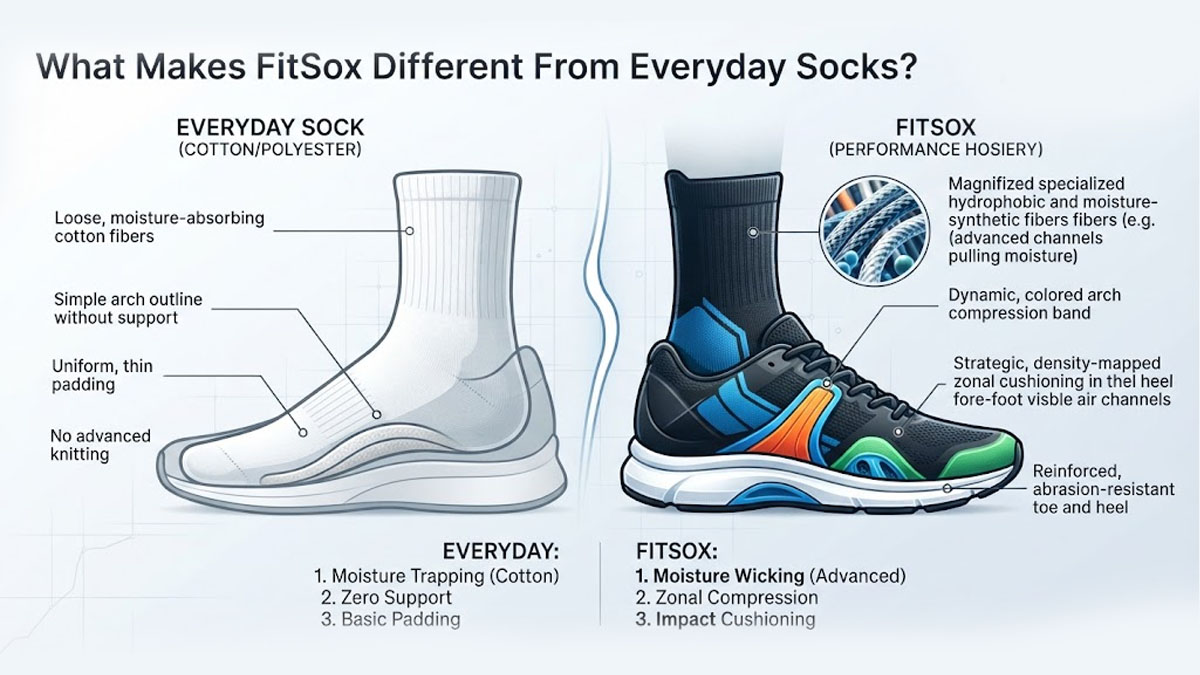
The distinct functional advantages of FitSox over conventional everyday socks can be categorized into three core pillars: material composition, structural support, and moisture management.
| Feature | Everyday Socks | FitSox (Performance Hosiery) |
| Primary Material | Standard cotton or low-grade polyester blends | Advanced technical synthetics (Merino wool, nylon, spandex blends) |
| Moisture Control | Retains sweat, leading to dampness and blisters | Advanced wicking channels pull moisture away from the skin |
| Arch Support | Minimal to none; uniform elastic tension | Anatomical targeted compression bands for arch stability |
| Cushioning | Even thickness across the entire footbed | Strategic zonal padding in high-impact zones (heel and forefoot) |
| Durability | Prone to thinning, stretching, and heel wear | Reinforced high-friction zones with abrasion-resistant stitching |
3. Key Technological Differentiators
A. Advanced Moisture Management and Thermal Regulation
- The Everyday Sock Flaw: Cotton is hydrophilic; it absorbs up to 27 times its weight in water. During exercise, trapped sweat creates a high-friction, humid environment that softens skin and drastically increases the likelihood of blisters and fungal growth.
- The FitSox Solution: FitSox utilizes hydrophobic synthetic fibers and specialized knit patterns that facilitate evaporative cooling. By actively pulling sweat away from the epidermis, these socks maintain a dry microclimate around the foot.
B. Ergonomic Zonal Compression
- The Everyday Sock Flaw: Standard socks stretch uniformly over the foot, providing little structural feedback or arch stabilization. Over long durations, this can exacerbate foot fatigue and plantar strain.
- The FitSox Solution: FitSox incorporates dynamic arch compression bands that hug the midfoot. This localized pressure supports the plantar fascia, reduces foot fatigue during repetitive impact, and prevents the sock from sliding or bunching inside the shoe.
C. Strategic Cushioning and Friction Reduction
- The Everyday Sock Flaw: Uniformly thin or overly bulky socks can create hot spots where shoe pressure concentrates, leading to skin shearing.
- The FitSox Solution: FitSox features density-mapped cushioning. Thicker, loops-knit padding is strategically placed under the heel and ball of the foot to absorb shock, while thinner, breathable mesh covers the top of the foot to maintain ventilation.
4. Conclusion
While everyday socks are adequate for sedentary or low-impact daily activities, they fall short when subjected to the mechanical and thermal stresses of rigorous physical movement. FitSox demonstrates that hosiery can be a sophisticated piece of athletic equipment. Through moisture-wicking engineering, anatomical arch support, and impact-absorbing zonal padding, FitSox bridges the gap between footwear and foot health, proving that the right socks are fundamental to peak performance and injury prevention.